Interstellar objects are large icy rocks, similar to comets, that formed around a different star and travelled for millions of years before reaching us. Only three have ever been spotted. The most recent, 3I/ATLAS, was discovered in July 2025 as it sped past the Sun and back out into deep space. The first was 1I/'Oumuamua in 2017, and the second was 2I/Borisov in 2019. These objects are not bound to the Sun. They follow hyperbolic trajectories, meaning they are moving too fast to be captured by solar gravity.
NASA Science reported on May 28, 2026 that 3I/ATLAS is the third known object to pass through our solar system from outside it. Based on Hubble Space Telescope observations on 20 August 2025, astronomers estimated the diameter of its nucleus to be not less than 1,400 feet (440 metres) and not greater than 3.5 miles (5.6 kilometres). When it was discovered, 3I/ATLAS was travelling at about 137,000 miles per hour (221,000 kilometres per hour). Pulled by the Sun's gravity, its speed rose to about 153,000 miles per hour (246,000 kilometres per hour) at perihelion, its closest approach to the Sun on 30 October 2025 at about 1.4 astronomical units, just outside the orbit of Mars.
NASA Science also reported that there was no danger to Earth. On 19 December 2025 the comet was about 1.8 astronomical units (about 170 million miles, or 270 million kilometres) from Earth. It was discovered by the NASA-funded ATLAS (Asteroid Terrestrial-impact Last Alert System) survey telescope in Rio Hurtado, Chile and reported to the Minor Planet Center on 1 July 2025. The comet approached from the direction of the constellation Sagittarius. It has an icy nucleus and a coma. NASA missions including Hubble, Webb, SPHEREx, TESS, Lucy, MAVEN and the Mars rovers observed the visitor.
The new composition study was led by Dr Lea Ferellec, a Research Fellow in Northumbria's School of Engineering, Physics and Mathematics. The work was carried out with colleagues at the University of Edinburgh, including Cyrielle Opitom and Colin Snodgrass. The team used WEAVE (the William Herschel Telescope Enhanced Area Velocity Explorer), a new-generation spectrograph on a powerful telescope in the Canary Islands. The observations were made with the 4.2-metre William Herschel Telescope (WHT) on La Palma. The paper, titled 'Ion abundances in the plasma tail of 3I/ATLAS show that it is N2-rich', was published in Monthly Notices of the Royal Astronomical Society.
Key Facts
Northumbria University Newsroom reported on September 8, 2026 that the team identified five different charged molecules in the stream from 3I/ATLAS at once. This is something rarely achieved for a comet, let alone an interstellar object. The five ions are N2+, CO+, CO2+, H2O+ and CH+, according to the MNRAS paper. By measuring how much dinitrogen gas was present compared to carbon monoxide, the researchers worked out that 3I/ATLAS formed somewhere extremely cold, likely colder than minus 240 degrees Celsius. This suggests it formed a long way from its home star, in the outer, icier edges of wherever its solar system took shape.
Astronomy Now reported on September 8, 2026 that the observations revealed unusually large quantities of nitrogen in the comet's gaseous plasma tail. As sunlight heats a comet, gases released from its nucleus can become ionised. These ions are then swept away by the solar wind to form a plasma tail. By spreading the tail's light into a spectrum, astronomers can identify the different ions within it. The team measured the abundance of ionised molecular nitrogen, N2+, relative to ionised carbon monoxide, CO+. The unusually high ratio points to temperatures below about 33 kelvin (minus 240 degrees Celsius), placing its formation far out in the frozen reaches of its original planetary system.
MNRAS/arXiv reported on September 4, 2026 that the paper derives a lower limit of N2/CO > 0.023 plus or minus 0.001. This indicates that 3I/ATLAS is N2-rich compared to Solar System comets, a property which can be linked to cold formation conditions. The authors present WHT/WEAVE-LIFU observations of 3I/ATLAS performed post-perihelion on 2025 November 30 and 2025 December 2. They simultaneously detect the ions N2+, CO+, CO2+, H2O+ and CH+ located in an anti-solar tail. Using common fluorescence factors, they determine abundance ratios of these species in the tail. The paper also investigates whether these ratios vary along the tail and detects only a marginal decrease of CH+ with cometocentric distance.
The paper is 7 pages with 4 figures and is filed under Earth and Planetary Astrophysics and Astrophysics of Galaxies. It was submitted on 4 September 2026 and published in MNRAS with DOI 10.1093/mnras/stag1402. The abstract notes that interstellar objects allow us to compare the early planetary formation process in the Solar System and around other stars. The second and third interstellar objects, 2I/Borisov and 3I/ATLAS, showed visible signs of activity, making it possible to assess their composition via spectroscopic analysis of their gas coma. Dr Ferellec said, according to the Northumbria University Newsroom: "This object gives us a rare chance to study material that formed somewhere completely different to our own Solar System. Finding that it's so rich in nitrogen tells us it likely formed in extremely cold conditions, far from its home star."
Analysis
What this really means is that the nitrogen to carbon monoxide ratio in 3I/ATLAS is a chemical thermometer for a world that formed around another star. Nitrogen is a hypervolatile, meaning it stays in ice only at very low temperatures. In the Solar System, comets are generally poor in nitrogen compared with what the team found in 3I/ATLAS. The measured lower limit of N2/CO > 0.023 plus or minus 0.001 is therefore a strong clue. It points to formation below about 33 kelvin (minus 240 degrees Celsius). That is colder than the typical temperatures in the region where many Solar System comets are thought to have formed. It places the birth of 3I/ATLAS far out in the frozen reaches of its original planetary system.
The judgement is that this object is not simply a rare visitor. It is a sample of a different chemical environment. The fact that WEAVE detected five ions at once, N2+, CO+, CO2+, H2O+ and CH+, makes the result more robust. The team also traced how the ions changed with distance along the tail, which is the first time this level of detail has been achieved for an interstellar object. The paper reports only a marginal decrease of CH+ with cometocentric distance. This suggests the tail remained fairly stable over the observed stretch. The observations were made post-perihelion on 2025 November 30 and 2025 December 2, after the comet had passed the Sun on 30 October 2025.
The bigger picture here is that planetary systems can build icy bodies at extreme distances, where nitrogen can be locked away. The abstract of the MNRAS paper notes that interstellar objects allow us to compare the early planetary formation process in the Solar System and around other stars. 3I/ATLAS is N2-rich compared to Solar System comets. That difference is the signal. It suggests that the comet's home system had a cold outer region, similar in some ways to the Kuiper Belt or Oort Cloud but not identical. There are caveats: the N2/CO value is a lower limit, and the authors used common fluorescence factors to derive abundance ratios. Abundance ratios between other ions cannot directly be used to constrain abundances of neutrals, although they seem consistent with 3I/ATLAS being enriched in hypervolatiles.
Why It Matters
The discovery adds a new data point to a very small set. Only three interstellar objects have been observed passing through the solar system: 1I/'Oumuamua, discovered in 2017; 2I/Borisov, discovered in 2019; and 3I/ATLAS. NASA Science reported on May 28, 2026 that 3I/ATLAS has an icy nucleus and a coma and follows a hyperbolic trajectory. It is moving too fast to be bound by the Sun's gravity. When it left the solar system it was travelling at the same speed as it entered. The comet came closest to the Sun on 30 October 2025 at about 1.4 astronomical units, just outside the orbit of Mars. It was about 1.8 astronomical units from Earth on 19 December 2025, so there was no danger to Earth.
The study matters because it connects the composition of an interstellar comet to the conditions in a planetary system that is not ours. The N2/CO ratio above 0.023 plus or minus 0.001 is not a trivial measurement. It required WEAVE on the 4.2-metre William Herschel Telescope. The work was led by Dr Lea Ferellec at Northumbria University with colleagues at the University of Edinburgh. The findings suggest that 3I/ATLAS formed below about minus 240 degrees Celsius, far from its home star. That is a direct link between a tiny icy body and the outer edges of an alien planetary system. The broader value is comparative planet formation. Because 2I/Borisov and 3I/ATLAS showed visible signs of activity, astronomers can use spectroscopic analysis of their gas coma. That is how the team detected N2+, CO+, CO2+, H2O+ and CH+ in the anti-solar tail.
Next Up
The immediate publication is the MNRAS paper, titled 'Ion abundances in the plasma tail of 3I/ATLAS show that it is N2-rich'. It is available via arXiv with the identifier arXiv:2609.05393 and carries DOI 10.1093/mnras/stag1402. The observations were made on 2025 November 30 and 2025 December 2. The paper is 7 pages with 4 figures. The team's lower limit, N2/CO > 0.023 plus or minus 0.001, gives other researchers a clear target to test with future instruments and future interstellar objects.
For now, 3I/ATLAS is heading back out into deep space. NASA Science reported on May 28, 2026 that it left the solar system at the same speed as it entered. The comet was discovered in July 2025 and reported to the Minor Planet Center on 1 July 2025. Its visit is over, but the data remain. As the Northumbria University Newsroom reported on September 8, 2026, the object formed in extremely cold conditions far from its home star. That conclusion will shape how astronomers interpret the next interstellar visitor.
Related Articles
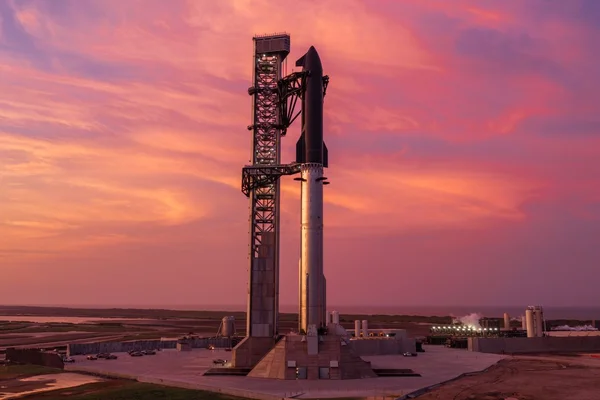
SpaceX Starship Flight 14 Eyes First Orbit With 20 Starlink V3 Satellites
Federal air traffic planners have reserved a two hour window on September 18, 2026 for a Starship mission that would fly about 20 Starlink V3 satellites and, per SpaceX's finance chief, bring in revenue.
Rocket Lab protests NASA's $700 million Mars orbiter award to Blue Origin
Rocket Lab filed a GAO protest on September 11, 2026, challenging NASA's $700 million Mars Telecommunications Network award to Blue Origin over eligibility and review concerns.
ESA Awards The Exploration Company 760 Million Euro Contract for Nyx Cargo Capsule to ISS
The European Space Agency has selected The Exploration Company to fly a reusable Nyx cargo capsule to the International Space Station under a contract worth up to 760 million euros.
Comments (0)
Log in or sign up to leave a comment.
No comments yet. Be the first to share your thoughts.