SpaceX has spent years turning central Texas into one of the busiest satellite factories on the planet, and it has now reached into the German equipment industry for the piece it cannot buy off the shelf: the machinery that makes solar cells. On November 10, 2026, Singulus Technologies AG, based in Kahl am Main, announced a supply contract with Space Exploration Technologies Corporation for a turnkey production line for heterojunction solar cells. The order is the first under a broader strategic partnership, and Singulus valued it at more than 60 million euros.
What makes the order unusual is its destination. These cells are not headed for rooftops or utility farms. They are meant to power Starmind, the constellation SpaceX has described as a network of solar-powered satellites built to run artificial intelligence workloads in orbit. Company materials describe satellites with localized compute that exploit the power and cooling available in space and beam results back through high-bandwidth lasers linked to the Starlink constellation. That architecture differs from Starlink itself, which primarily relays broadband traffic.
The cells at the center of the deal are heterojunction devices, known in the industry as HJT. The design pairs a crystalline silicon wafer with thin layers of amorphous silicon that reduce charge loss at the wafer surfaces, lifting efficiency above what a plain silicon cell can manage. Making them is a multi-step process: the wafer is cleaned, thin films are deposited, and the stack is thermally treated. Singulus is supplying wet-chemical processing equipment alongside PVD and PECVD vacuum coating tools.
The partnership did not begin with this contract. Singulus said the relationship with SpaceX started in March 2026, and that SpaceX provided significant funding to the supplier that month and again in October 2026 as part of a recently announced subordinated secured loan. In its 2026 securities filing, SpaceX outlined an ambition to deploy up to 100 gigawatts of power to orbit annually, an objective it said would require thousands of launches each year.
Key Facts
Singulus reported on November 10, 2026 that the first line under the agreement carries an order volume of more than 60 million euros and is scheduled for delivery in the first half of 2027. The company said the contract sits inside a partnership under which it plans multiple additional lines, and that production will scale to support more than 100 gigawatts of production equipment as SpaceX accelerates satellite manufacturing in Bastrop, Texas. Singulus did not specify the output of the first line itself.
Elon Musk supplied the scale that the press release left implicit. In a post on X, he wrote that SpaceX had ordered 100 gigawatts per year of HJT solar manufacturing equipment from Singulus in Germany, adding that the order is for Starmind, which he described as an effort to create a sentient sun. Live Mint reported on November 12, 2026 that SpaceX confirmed the deal and that Musk characterized the order in those terms. The gap between a single line worth more than 60 million euros and an annual figure of 100 gigawatts is the story inside the story.
Both companies put executives on the record. Mike Nicolls, Senior Vice President of Starlink at SpaceX, said partnering with Singulus gives the company a high-performance manufacturing path for solar cells for its Starmind satellites at its Texas facility, and that process expertise plus long-term commitment creates a durable option for scaling solar production. Lars Lieberwirth, a member of the Singulus executive board, said the platform approach combines wet chemistry, vacuum coating and thermal processing, and that the partnership lets the company industrialize those capabilities at meaningful scale.
The demand signal is visible in regulatory filings. Stocktwits, in a report carried by Yahoo Finance on November 10, 2026, noted that SpaceX has filed with the U.S. Federal Communications Commission for authority to operate up to one million Starmind satellites, with first launches expected in the latter half of 2027. Reports cited in the coverage say SpaceX aims to place around 10,000 Nvidia server racks into orbit by 2028. SpaceX's published AI1 specifications describe a deployed height of 30 meters, a wingspan of 75 meters and a payload drawing up to 250 kilowatts at peak and 175 kilowatts on average.
Analysis
The arithmetic deserves a test. A single turnkey line priced above 60 million euros cannot produce 100 gigawatts of cells a year, and Singulus never claimed it would. The company said production will scale to support more than 100 gigawatts of production equipment, language that describes a multi-line buildout rather than the first shipment. Musk's post converts that hedge into a rate: 100 gigawatts per year of equipment. Together, the two statements imply a rolling procurement program in which the November contract is the template, the qualification run and the down payment at once.
What this really means is that SpaceX is treating solar cell manufacturing as a strategic input to be owned and localized rather than a commodity bought on the open market. Satellite constellations have always been constrained by power, but Starmind pushes that constraint to the center of the design. A 75 meter wingspan and a 250 kilowatt peak payload describe a machine whose usefulness is set by watts per kilogram and by how fast its cells degrade in orbit. When the power budget determines the compute budget, the factory that prints the cells becomes as important as the launch pad.
The choice of a German supplier is also a statement about where the equipment chain sits. Singulus has built its business on wet chemistry, vacuum coating and thermal processing, the process families that HJT requires, and is now being asked to industrialize them at a scale it has not served. Interesting Engineering reported on November 10, 2026 that the first turnkey line is scheduled for delivery in the first half of 2027 as part of the wider partnership, while noting that Singulus did not specify first line output. The financing is equally telling: SpaceX put money into its supplier in March 2026 and again in October 2026 through a subordinated secured loan, the behavior of a customer that needs capacity to exist before it needs it to be cheap.
For investors, the reaction has been muted. Stocktwits reported on November 10, 2026 that SPCX was trading at about 142 dollars, above its June IPO price of 135 dollars but below its all-time high near 225 dollars. That is a stock pricing a long execution path, and the Singulus contract does not shorten it. The bigger picture here is that the binding constraint on orbital compute has moved from launch cost to manufactured power, and the companies that can deliver solar cells at gigawatt scale will set the tempo for everyone else.
Why It Matters
Terrestrial AI infrastructure runs into limits that are physical before they are financial: land, grid interconnection, water for cooling and the social license to build. Starmind is a bet that those limits can be routed around rather than solved, with sunlight in a sun-synchronous orbit providing continuous generation and the vacuum of space providing heat rejection. Whether that bet pays depends on unglamorous details, and the solar cell is the first link. Small efficiency gains translate into either more compute per satellite or fewer satellites for the same compute.
The contract converts an ambition into a schedule. Delivery in the first half of 2027 and first launches in the latter half of the same year give the program a cadence that can be checked. If the line slips, the launches slip with it, because no second source appears in the materials. That single point of failure is a familiar pattern in SpaceX's vertical integration strategy, and it works only when the supplier is treated as part of the program rather than as a vendor.
For the equipment industry, the deal is a reminder that the solar manufacturing supply chain is a strategic asset. Singulus is a mid-sized German company listed under WKN A1681X, and it has now been pulled into the capital plan of the largest launch provider in the world. If the multi-line program proceeds, the second order effect is a European equipment maker scaling to volumes the terrestrial solar market alone could not offer.
Next Up
The milestones to watch are delivery of the initial line in the first half of 2027, qualification of cells from that line, and the start of Starmind launches in the latter half of 2027, all contingent on the FCC granting authority for up to one million satellites. Also on the calendar: the reported plan for around 10,000 Nvidia server racks in orbit by 2028, and SpaceX's stated intention to produce advanced AI chips at scale in a new fab run as a joint project with Tesla.
Singulus has said it plans multiple additional lines but has not disclosed their number, timing or value. Musk has said the order runs at 100 gigawatts per year. The distance between those two statements is the space in which this story will develop.
Related Articles
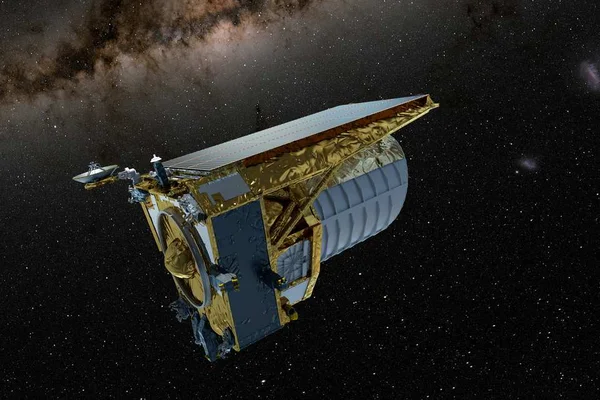
Euclid releases 1.7 petabytes of survey data cataloguing 900 million galaxies
Europe's dark energy telescope published 13 months of observations, including 15,000 gravitational lens candidates, as astronomers build a three dimensional atlas of the cosmos.
Rakuten and AST SpaceMobile form 51/49 joint venture for Japan's 148 billion yen satellite network
Japan's communications ministry has routed a three-year, 148 billion yen subsidy to a new Tokyo-based operator that will lease satellites from a Texas manufacturer and sell coverage to domestic carriers.
Rocket Lab Books Over $515 Million in Neutron Contracts and Lifts Base Price to $70 Million
Rocket Lab has secured more than $515 million in Neutron launch deals across eight missions, raising the unflown rocket's base price to $70 million as its first flight slips to 2027.
Comments (0)
Log in or sign up to leave a comment.
No comments yet. Be the first to share your thoughts.